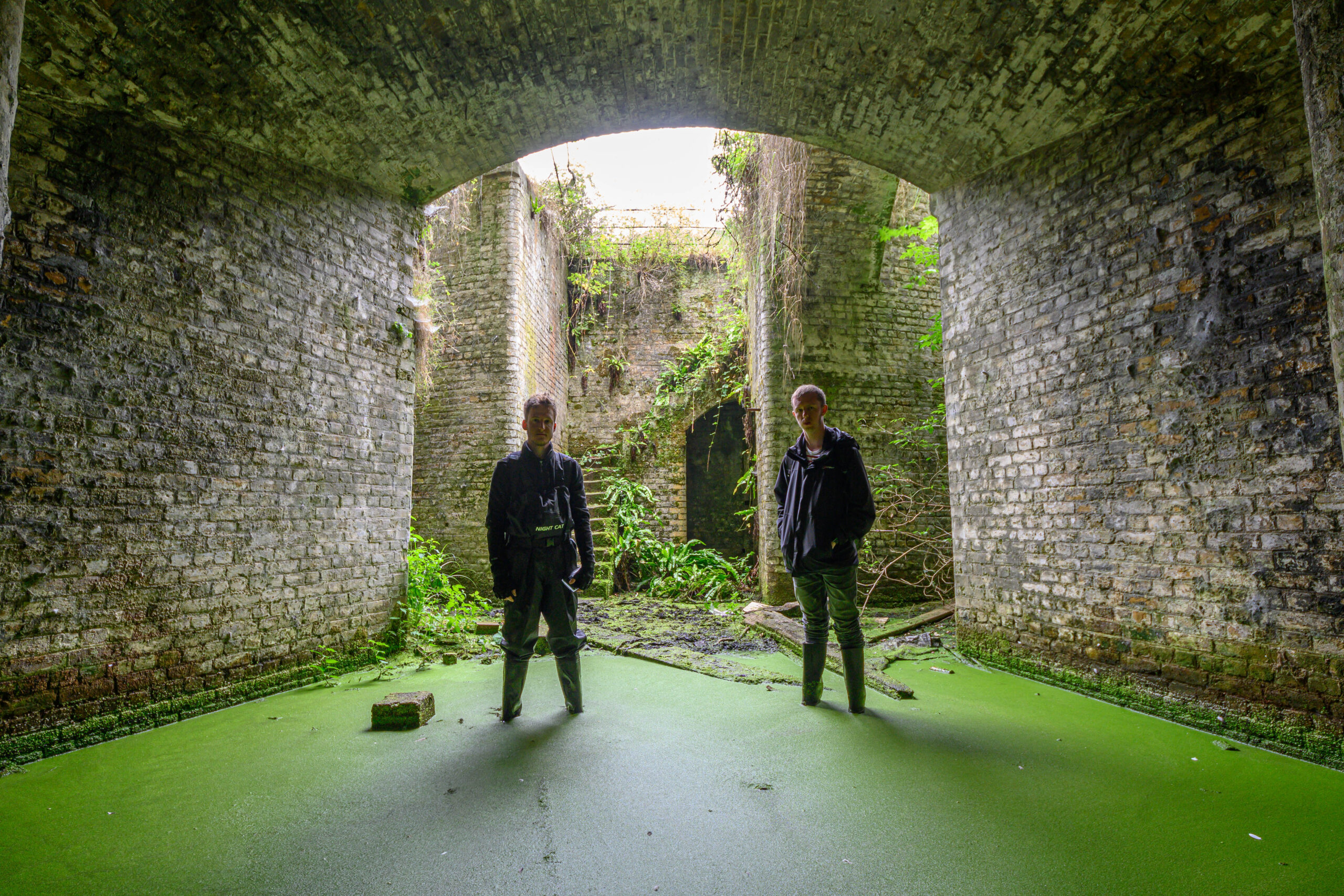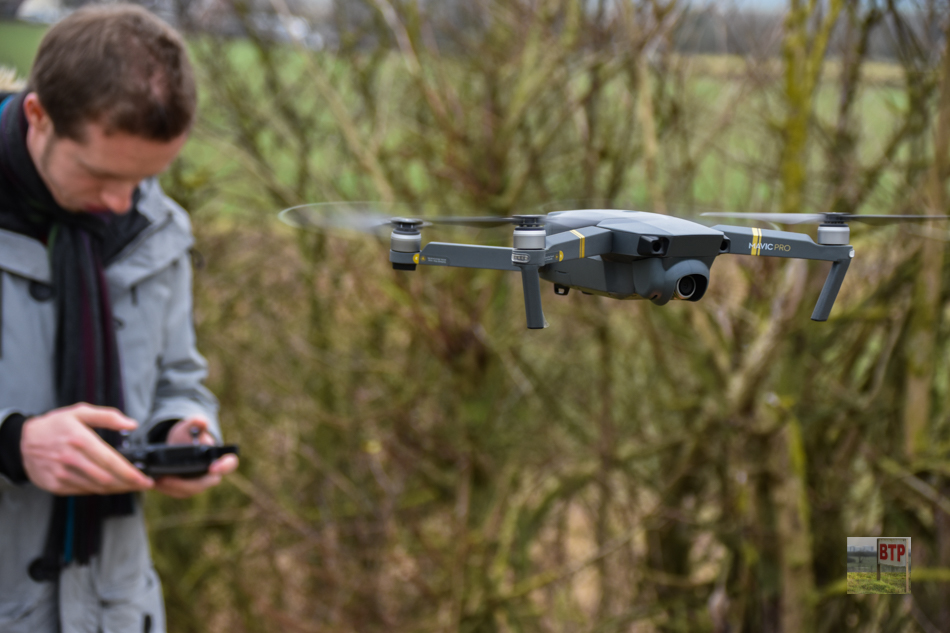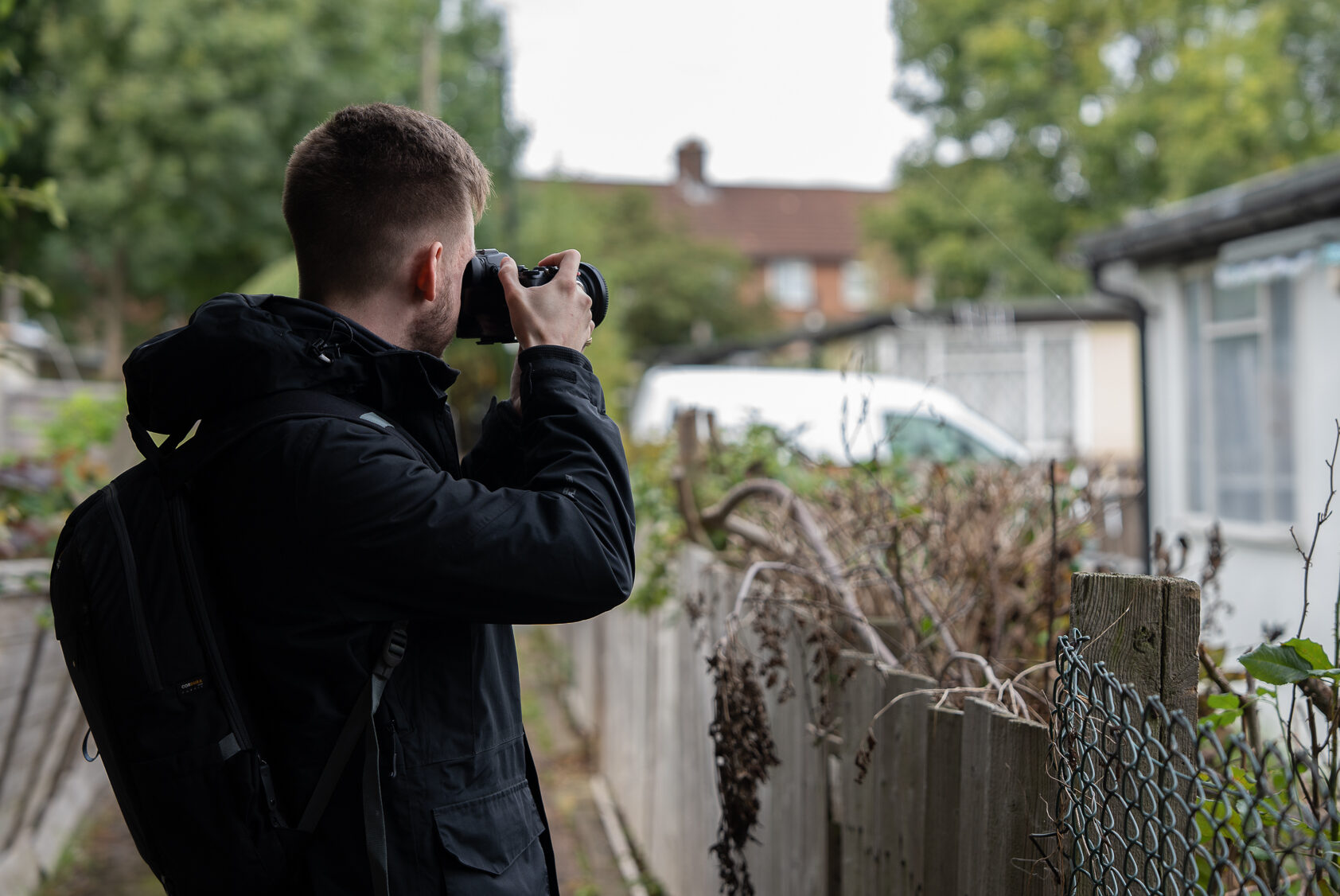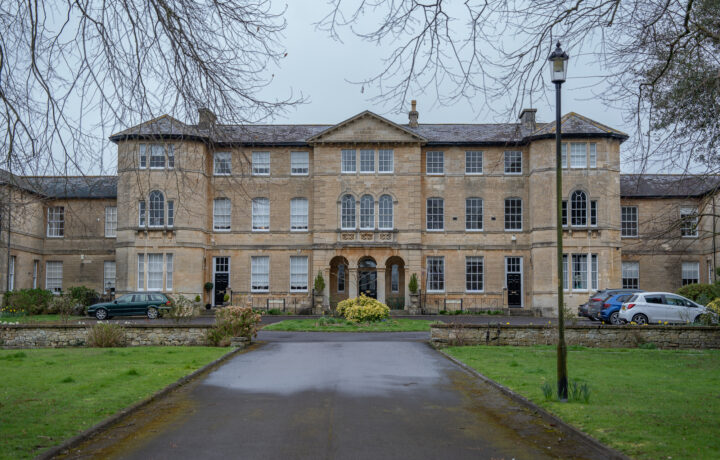
If you have 2 minutes, why not complete our SPAM FREE questionnaire so that we can improve Beyond the Point? LINK

At the outbreak of World War II, the Port of London was the busiest port in the world. As such, a large proportion of supplies to the UK entered by ships navigating the Thames. The German Navy quickly sought to put a stranglehold on this route, and to this end, utilised a new secret weapon – the magnetic influence mine. Whilst there were different variants of this mine, in simplistic terms, the mine was detonated by the presence of a large magnetic object – such as a steel hulled ship – passing in close proximity, without having to make physical contact. So successful was this that in the first few months of the war, over one hundred ships were sunk in the Thames Estuary alone. It was clear that urgent action was needed to stem these losses, and as most mines were laid by aircraft, ships were requisitioned and used as mobile anti aircraft units. However, this was not altogether successful, and a more satisfactory solution was needed.In the early years of the war, Guy Maunsell, a civil engineer, had produced plans for offshore defences.

At the time his ideas were considered somewhat eccentric, but he was asked to submit plans for an offshore fort as an effective means of dealing with the laying of the mines. Plans were drawn up, and after some modification, approval was given for the manufacture and installation of four offshore forts. These were of mainly reinforced concrete construction, built on land on a lozenge shaped reinforced base, and towed out to sea where they were sunk onto the seabed.

The source for this blog post

Each fort accommodated approximately 120 men, housed mainly within seven floors of the 24’ diameter twin reinforced concrete legs and were under the control of the Navy. They were all placed in position between six and twelve miles offshore between February and June, 1942 and became operational immediately. Each fort accommodated up to 265 men.

war

After the war the forts were placed on ‘care and maintenance’. However as the need for their continued use diminished, they were abandoned, and the guns removed from the Army forts, in 1956.The Nore fort was dismantled in 1959 being considered a hazard to shipping (two towers were lost following a collision in 1953 whilst another in 1963). In 1964, Radio Caroline began broadcasting from a ship moored outside UK Territorial Waters.

Four of the forts survive, abandoned since they were decommissioned in the 1950s. Each played host to pirate radio stations in the 1960s. Since this time, Roughs has been occupied by the founder of Radio Essex, Roy Bates, who in 1967 declared the fort an independent state: The Principality of Sealand. Its independence is not recognised and as with all the Maunsell forts, it is still considered UK territory (though this is often disputed). In 2007, there was talk of The Pirate Bay relocating to Roughs, in a bid to take advantage of its disputed territory claim and get around toughened copyright law in Sweden. This fell through. The plans can be seen below. (Right click image then select open in new tab to enlarge the picture)

This slideshow requires JavaScript.

Today, Redsand Fort as the only complete structure as built in wartime is the focus of attention by Project Redsand, a group of enthusiasts with the aim of reinstating the Fort to its original built condition. Having had an underwater survey carried out by the Port of London Authority at a cost of around £5,000, work has progressed to installing a new access system to the G1 tower thanks to the generosity of Mowlem Marine (now Carillion) of Northfleet. Built at a cost of approximately £40,000, the access system enables project members to board the tower to commence restoration. The BTP Boys hope to venture out one day!

Useful Websites:

Project Redsand - http://www.project-redsand.com/index.htm

Maunsell Forts - http://log.doggerland.net/2011/02/23/maunsell-forts/

1943 Pictures - https://www.facebook.com/media/set/?set=a.355003671221371.102739.100281160026958&type=3

Thursday 31st January 2013 marks 60 long years since Canvey Island was hit by an abnormal storm causing mass flooding and damage to many many people’s property and lives. The horrific event terrorised Canvey however the whole of the Essex coast was affected as well as other places.

Canvey+Island,+Essex

Saturday 31st January 1953 began in Essex like any other mid-winter Saturday, however the outcome was a surprising revelation for everyone… On Canvey the new memorial hall, gaily bedecked with bunting, was publicly dedicated in the afternoon to the memory of local men who lost their lives in the Second World War. On the mainland opposite Canvey, caretakers and cleaners gave the new Benfleet secondary school in Shipwrights Drive, sometimes referred to locally as ‘The Palace’, the final polish for its official opening. At 11pm at Tewkes Creek the wind was fresh, cold and fierce. Shortly before midnight, one or two nightfarers, who was a Roman Catholic Priest who was old visiting a sick parishioner. In the bright moonlight he saw the tide lapping the top of the wall. In the Sunken Marsh a river board employee who lived nearby realised that the tide was rising rapidly. At might night, the chilling water was closing in on the whole of the Essex coast. Flooding in varying degrees had begun, and was spreading as the tide continued its inexorable rise and overwhelmed the defences on an ever-lengthening front which the weight, height and duration of its attack.  At this time, just before 1am, dykes were starting to overflow and the electricity board has received a report of a fault on Canvey due to flooding. At 12:50am, the water was at the top of the wall at Smallgains, this section in fact has recently been raised and thickened and was about a foot and a half higher that the wall at Tewkes Creek. One of the river board’s men was blowing his whistle, which echoed in the howling wind. This was just gone 1am. A few minutes after this, the chairman had rung the police station to tell the sergeant that the flood boards at Canvey Bridge had been overtopped. The Police sergeant met a constable out on a bicycle patrol who was about to telephone the police station because although the tide the water was still a foot below the top of the wall, it was extremely high for the stage of the tide.

1am February 1st - Meanwhile, at the Newlands, the 2 river board men and a group of gathered dedicated citizens tried to rouse the elderly and the young. Stumbling in the moonlight across the muddy rutty unmade roads, up and down garden paths then went knocking, shouting and even one screeching at his whistle as a last attempt to save fellow Islanders. With the howling noise of the wind, corrugated roofs, wrought iron gates and loose shed doors it was a difficult task to stir residents.  However many people had no warning and were awakened by the sudden roar as the wall burst, by the swish of the water as it rushed past, by the clatter and crash of the debris striking the house, by the noise of splitting timber and smashing glass. Half-awake, dazed and bewildered, as they struggled to escape from this violent, engulfing nightmare, to reach the outdoor staircases to their lofts, or to fight their way through the tumult outside, to go to the aid of elderly relatives or neighbours living nearby, successive waves charging through the walls swept them off the feet, breathless and numb from the icy impact. The margin between life and death was a matter of seconds as the water gushed through shattered windows and doors, and, impounded as it was in the Sunken Marsh by the inland counter wall, with no means of dispersal; it rose rapidly to a lethal depth.

Many who clambered on chairs, tables, cookers, mangled-tables and step-ladders, to keep their heads above the water or to make holes in the flimsy ceilings in order to escape into the roof space or out onto the roof, found their supports swept away from under their feet, leaving them fighting in the dark with floating furniture, clutching desperately at fanlights and the tops of doors and wardrobes, and trying to hold children up above the suffocating water. The Sunken Marsh was well described as a ‘basin of death’… By 1:25am the water was above windowsill level at the Newlands end of the Sunken Marsh, and, over topping the counter wall, was already pouring over it into the low ground between the counter wall and the High Street.

Have lessons been learnt though?

——————————————————————-

This is just a little bit of what happened on that awful night. Liam and I are in the process of filming a documentary DVD to commemorate those that died and also the people that were affected by the floods. We are attending several events to pay our respects and also to film. If you have a story on the floods or know someone that does, we would be greatful if you would share it with us.

 The Peasant’s Revolt of 1381 is a subject recognized by most of us around the country, even if we have only heard about the individual ‘Wat Tyler’. What some of us know, is that it all began in Essex, that’s why it fits in nicely with BeyondthePoint.co.uk, as we reveal to you this not usually talked about side of Essex’s history.

It all began with the Black Death – the Bubonic Plague, of 1349. So many people were killed and effected by the widespread disease, and it was brought over on ships by foreign rats which let off fleas carrying the menace. The population of England was cut drastically, and now, there was no longer a large body of peasant workers. This meant that those who were left tried to haggle their masters a higher pay, to make up for the lack of ‘employees’. The government, which had none of this, far detached form its people, deiced to revert their wages back again. To add insult to injury, they brought in ‘the third medieval poll tax’, allegedly to fund the country’s overseas interests. This heightened tension between the gentry and peasants, which were suffering poor lives due to the strongly hierarchical ‘Feudal System’ – a system which clearly outlined the status and power of social classes, common throughout the mid medieval period. This tax was one of three groats per person, no matter how poor, meaning those who were poor would suffer, while those richer would not – there was no discretion given according to wealth. With a slave-like serfdom enslaving the people, they were not happy. Having to work up to two days a week on church land was not popular.

A perhaps over-grisly photographic reconstruction of a mob of revolutionaries gathering near the Tower of London, with Wat Tyler at front wielding a large two-handed sword.

A perhaps over-grisly photographic reconstruction of a mob of revolutionaries gathering near the Tower of London, with Wat Tyler at front wielding a large two-handed sword.

In 1381, peasants began to protest and did not pay their tax. A tax collector visited Fobbing in Essex to investigate, only to be forced out by the peasants. Another event later occurred in Brentwood, where the party was attacked, and violently, six officials were killed. Other local villages joined the righteous disarray. The misconduct soon spread to Kent, and a rebellion occurred at Maidstone. Wat Tyler, a mysterious character, here joined the fray. He was believed to have been born in Brenchley, Kent, according to local tradition, although historians say he was born in Essex. Two more instigators joined the battle to lead the Essex side of the gathering into London. John Ball was a priest of reformed Christianity of the time, known as ‘Lollardy’, who was situated in Kent at time of rebellion, although lived in Colchester prior to then. Jack Straw was a man who has also been referred to as Rackstraw and John Rakestraw, was probably a priest or preacher, was allegedly provoked to rebel after an assault on his daughter by a tax collector, and was in this source called by the alias of ‘John Tyler’ leading the speculation that he was in fact the same man as Wat Tyler himself. While Wat Tyler supposedly lead the Kentish rebels, Straw was said to have led those of Essex. One source describes how he lead a crowd into the main rebellion, on its way to London, from St. Mary’s Churchyard, Great Baddow, Essex.

St. Mary's Church, Great Baddow, where Jack Straw gathered Essx's rebels in the churchyard before he led them to London. Note the church was heavily restored over 100 years go since its contemporary incarnation at the time of the revolts.

St. Mary’s Church, Great Baddow, where Jack Straw gathered Essx’s rebels in the churchyard before he led them to London. Note the church was heavily restored over 100 years go since its contemporary incarnation at the time of the revolts.

The rebels soon met up in their thousands at the capital, London, where they caused blood-stained havoc. The Savoy Palace – where the Savoy hotel stands today, was burnt to the ground, as a royal residence to the king’s uncle John of Gaunt. The Tower of London was under siege, and  eventually, the rebels broke inside. rushing to the chapel, priests and those of high authority to the tax, were torn away to the traitor’s area of Tower Hill, where they were beheaded viciously one by one. their heads – stuck on stakes, and shown around the city as a warning and a victory. On the following day, a meeting was held to reconsider the clearly disputed taxes – June the 15th. King Richard II rode out to meet the ravening mob, and Wat Tyler mockingly rode close in a taunting manor to the king and his horse. Suddenly, a temper-filled squire threw him down, and ran him through with his sword, in an unexpected, merciless flurry. This is what http://www.middle-ages.org.uk said:

He knocked Wat Tyler off his horse with a broadsword and as Wat Tyler lay on the ground one of the king’s squires stabbed him in the stomach, killing him. The English Peasants’ War was over. Wat Tyler’s head was cut from his corpse and displayed on London Bridge. John Ball was hanged, drawn and quartered in the presence of Richard II and his quarters were displayed in four other towns as a warning to other rebel. Jack Straw was executed and his head displayed on London Bridge. The promises made to the rebels by Richard II were quickly withdrawn although the poll tax was abolished.

The Savoy Hotel today, London, on the site of the Savoy Palace raised by the peasants in 1381.

The Savoy Hotel today, London, on the site of the Savoy Palace raised by the peasants in 1381. A great shot from ‘E-Architect’ website.

Following the loss of all their leaders, the peasants lost their courage and became a broken crew. The fleeing peasants then went to Essex, Unsure of what action to take next. It was at Billericay, where the Battle of Billericay took place in Norsey Wood. The royals followed in pursuit, without a care to listen to the majority. They came and brutally murdered around 500 peasants encamped at the wood that day.

Norsey Wood, Billericay, where the remaining retreating peasants from London were slaughtered. From 'geograph.org.uk'

Norsey Wood, Billericay, where the remaining retreating peasants from London were slaughtered. From ‘geograph.org.uk’

Despite being fueled by bloodshed, the revolts of 1381 did have a positive outcome:

1.On the surface, the peasants were crushed, their demands denied, and many executed. However, the land owners had been scared, and in the longer term several things were achieved.

2. Parliament gave up trying to control the wages the landowners paid their peasants.

3. The hated poll tax was never raised again.

4. The Lords treated the peasants with much more respect. They made more of them free men ie. they were not owned as part of the land. This benefited in the end, as free men always work much harder.

5. This marked the breakdown of the feudal system, which had worked well during the early Middle Ages, but was now becoming outdated as attitudes were beginning to change.

  I hope you enjoyed this long yet flavorful insight into the events of 1381, and have learnt what happened - especially in Essex. If Medieval local history floats your boat, explore this site for articles and a 30 minute documentary on Hadleigh Castle.

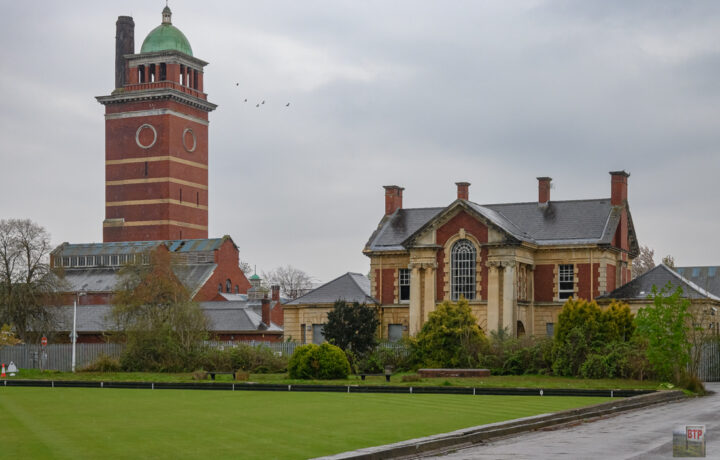
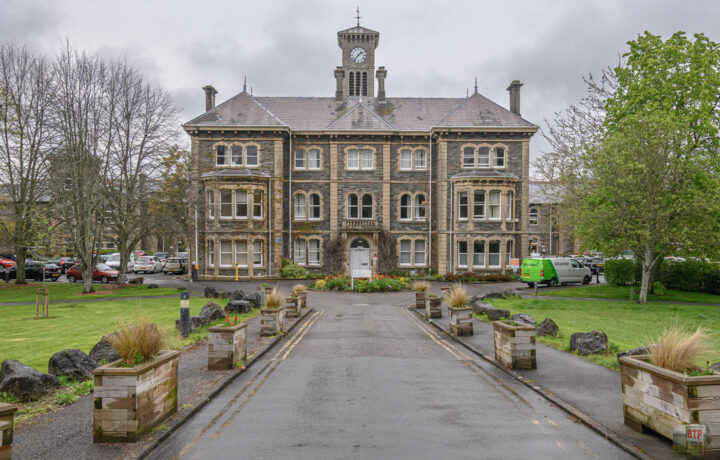
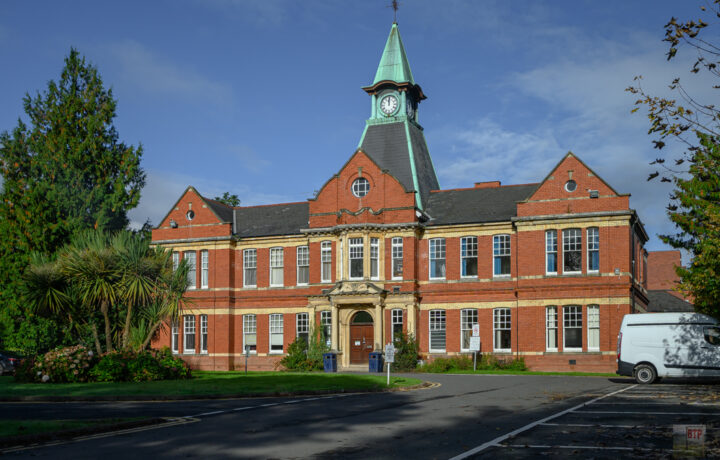
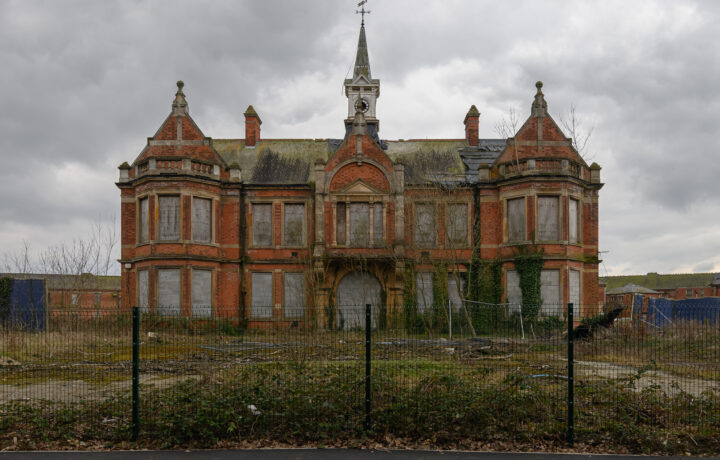
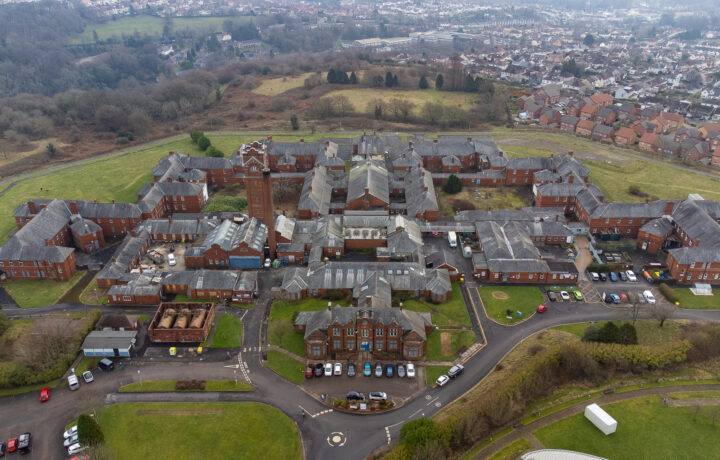
Runwell hospital is situated in Essex and after 73 years of treating mental illness, has closed it’s doors. The hospital is particularly known for the study and surgery on the human brain and we went to visit the site!

6

The hospital was fully closed on April 23rd 2010 with fences being placed on access roads soon after. The site had been earmarked for a new 1,500-inmate male prison but the plan was formally withdrawn following a Ministry of Justice spending review in December 2010. In February of 2012, plans were announced to construct around 600 new homes on the site. Demolition started in July 2012 and the only buildings to remain will be: the administration building (front part with clock tower), the water tower, and the Grade 2 Listed Chapel of Saint Luke.

5

We arrived at the site in good time, although after trekking through several fields, we arrived at the back of the site.

This slideshow requires JavaScript.

Each ward had its own name which stood for something medical. We saw the Margaret/Nightingale and also the Sandringham/Windsor ward which was the Male Long Stay.

8

Male Long Stay

7

Unknown

We couldn’t gain access to the buildings as they were sealed off, however there was 1 room that was open (a cleans cupboard or something) that had a strange surprise lurking inside…(Picture isn’t suitable for BTP readers; lets say that! ;) ) We walked around the site seeing the different wards however it was solidly locked up! One of the buildings that wasn’t locked up was the high security bit in which the original fences remained. After seeing this we headed towards the water tower and saw demolition that had been started. We decided not to walk over there.

9

Demolition Work

10

The water tower

The water tower was also locked up and we couldn’t get in, however this picture shows the inside from someone’s previous visit.

Inside the water tower/boiler house

11

12

BTP Liam filming the documentary which will be coming soon!

13

The rest of our photos are available here. This was a good visit and our first abandoned medical establishment however it wont be the last! If you have any places for us to visit, drop us a comment below!

My, what a year 2012 has been for Beyond the Point! Celebrating our first birthday and a very strong year, me and Liam are proud of the progress that we have achieved. Every year WordPress (the sites software) releases a report on the website and ours is as follows…

Overview

4,329 films were submitted to the 2012 Cannes Film Festival. This blog had 18,000 views in 2012. If each view were a film, this blog would power 4 Film Festivals. In 2012, there were 57 new posts, growing the total archive of this blog to 109 posts. There were 722 pictures uploaded, that’s about 2 pictures per day. The busiest day of the year was August 30th with 299 views, thanks to our article in the Echo! The most popular post that day was the 1880-1920 pictures.

How did they find us?

Some visitors came searching, mostly for beyond the point,beyondthepoint.co.ukraf rivenhall,images of england canvey island book, and derelict places. The top referring sites (in order) were facebook.comderelictplaces.co.ukbeyondessex.co.ukcanveyisland.org then maps.google.co.uk.

Click here to see the complete report.

The BTP Boys!

The Boys in Action

What a successful year it has been! 2013 is around the corner and that is going to be better. We are currently in the process of writing and filming our DVD on the 1953 Floods to commemorate the victims of the events and we have also just re-designed our forum to a more ‘BTP’ style. We have some plans of places to visit and indeed, things to write about. None of this would be possible without the support of YOU! Thank you so much and we wish you a successful new year.

Churchill at Shoebury fires the Sten Gun

Posted: December 27, 2012 by BTP Liam in Case Study, Various
Tags: , , ,

For a few years now I have seen the below photograph of Sir Winston Churchill test-firing the ‘Machine Carbine, Sten’, which is most commonly known as the Sten sub-machine gun. A sub-machine gun is a fairly small machine gun which fires pistol-sized bullets (pretty much any fairly small machine gun which is smaller than a rifle), and the Sten was Britian’s own which served through World War Two up until the 1960s. It was an answer to avoid having to import expensive Thompson sub-machine guns (a.k.a. ‘Tommy Guns’) from America, although it was cheap and not very sturdy. Despite this, it had a slower rate of fire and greater accuracy than the Tommy gun, meaning it could be utilized at greater distances effectively. It was Brtian’s own SMG, and was issued to non-front-line troops (as a self-defense weapon for artillery firers e.t.c.), to officers, and to the Home Guard, as well as Commandos who favored stealthy combat, and Paratroopers who needed a lightweight and compact weapon when they jumped. Others were given Lee-Enfield rifles.

Little did I know that this photograph of Churchill with the Sten was taken at the experimental battery in Shoebury (see more on the remains/history of the place on this site), now ‘Gunner’s Park’ – a nature reserve holding numerous battery constructions. It was taken in 1941, and it’s owner – the Imperial War Museum, states

Caption Winston Churchill took aim with a Sten gun during a visit to the Royal Artillery experimental station at Shoeburyness in Essex, England, United Kingdom, 13 Jun 1941
Photographer Horton


person_churchill2

A Sten Mk.II – This was the most common type of Sten used in WW2